Showing posts with label Questions. Show all posts

Monday, October 2, 2017

Is Carlos Beltran a Hall of Famer?

In the spirit of revival, as I do my best to bring the blog back to relative activity, I'm bringing back a small feature I did that I like to call, "Is He a Hall of Famer?" It was started by Other Joe, as he posited that Jorge Posada was not deserving of a place in Cooperstown.

The question was brought up by a Twitter follow of mine, Josh Reese, who works in Houston sports:


The reaction among his comments was overwhelmingly in favor of Beltran's status as a surefire future Hall of Famer. My initial reaction was that he's a good player, but not ultimately destined for the Hall. Like any good baseball question, though, this is the kind of thing we figure out with statistics.

Arguments in Favor

Beltran's career triple crown numbers are...solid. He has a career batting average of .279 with 2,724 hits, 435 HR, and 1,587 RBI. The numbers are eerily similar to HOFer Andre Dawson (.279, 2,774 438, and 1,591). Obviously the numbers don't cross the magic thresholds of 3,000 hits and 500 HR (neither of which I expect Beltran to surpass before retirement), but they're very good.

He also raised his game during the playoffs, upping his average to .323 across 55 postseason games and mashing 16 home runs, including 8 bombs in two series with the Astros in 2004.

Beltran has been a big-time run producer, notching seven seasons of at least 100 runs and eight seasons of at least 100 RBI. Again, very good numbers.

Arguments Against

Of course, the Hall of Fame isn't for players who are "very good." It's for the ultimate elite in baseball history. Andre Dawson's numbers were accumulated in a much weaker offensive era, a period when baseball went from 1978 through 1989 without anyone hitting 50 home runs. During Beltran's career, 22 different seasons of 50+ home runs have been recorded.

Also worth noting is that the Hall of Fame, historically, has been meant to reflect the players who were at the top of the game during their careers. The players who most frequently are elected to the Hall of Fame are those who have league-leading statistical seasons, MVP seasons, Cy Young seasons, etc.

Albert Pujols is a great example. He'll undoubtedly be a Hall of Famer, and probably a first-ballot Hall of Famer. He finished first in MVP voting three times, and four other times he finished second or third. He led the league in HR twice, R five times, SLG three times, and a number of other top finishes. Beltran has led the league once...in games played. He did win Rookie of the Year, which puts him in such elite company as Raul Mondesi, of embezzlement fame.

Tying It All Together

In the end, the argument usually ends up somewhere in between. This time, we've got a pretty fair comparable player we can use to determine what we should think about Beltran: Gary Sheffield. Sheffield came into the league a little bit earlier, but his playing prime was right around when Beltran's was. He won a single batting title, but overall shared Beltran's lack for individual accolades. He generated impressive power numbers during a period when everybody was generating impressive power numbers.

His final tallies come in at a .292 batting average, 2,689 hits, 509 home runs, and 1,676 runs batted in. I think you can fairly compare the two players, and I think the final verdict is going to be that Sheffield, while a very good player, is not a Hall of Famer. He picked up just 13% of the vote last year, in his 3rd year on the ballot. I don't expect he'll get anywhere near the late surge that Tim Raines or Bert Blyleven got. In the end, he'll likely be left on the outside looking in, as a member of the Hall of Really Good.

That's my call for Beltran as well.

Verdict: Not a Hall of Famer

Monday, August 11, 2014

Better Long-Term Gamble: Puig vs. Harper

Two years ago, Bryce Harper was the biggest news in baseball, a straight-out-of-high-school slugger who couldn't miss. Last year, the sport was abuzz with talk about Yasiel Puig, both his baseball skills and colorful character. Now that we've seen both of them play some baseball, it's a fair question to ask, which of these phenoms is more likely to evolve into an all-time great?

I was going to split the post into two sections, one about fantasy baseball and the other about real life baseball, but the results should be pretty much the same, really. So it's just one big discussion, split up into the various facets of their respective games.

Demographics
Bryce Harper is 2 years younger than Yasiel Puig, which is important to keep in mind. While Puig may not have spent that time facing major league pitching, he has had two more years to grow into his body and ply his trade. It's often stated (and sometimes overstated) that many hitters don't hit their power prime until about 26-27, so both players could offer even more power in the future. Which brings us to our first non-actuarial skill...
Advantage: Harper

Power
Today's baseball world is power-starved. We've had a couple of big seasons in recent years (Jose Bautista's 54 in 2010, Chris Davis' 53 last season), but it might surprise you to know that those are the only two times a player has hit 45 or more home runs since 2010. It's not likely that anyone will break that mark this season either. The baseball world needs more mashers. Initially, I expected Harper to win this category easily, but it turns out, the numbers had something else in mind.

Harper has averaged 28.7 plate appearances per home run, while Puig has averaged 28.0 per dinger. Part of that has to do with Harper's mostly disappointing 2014 so far at the plate, but consider this: Harper's highest slugging percentage in a given season is .486. Puig's lowest season (of 1+ so far) would be .528. Harper has more total home runs (46 to 32), but he's also played 100 more games. Again, Harper's got two fewer years of growth under his belt, but based strictly on the data we've got, Puig's got more pop.
Advantage: Puig

Hitting/Plate Approach
I don't think there's any fantasy baseball player out there who couldn't tell you that Puig is a beast when it comes to batting average. He hit .319 last year, and is rolling along at .311 this season. Harper averaged .272 over his first two seasons, and is down to .254 in his injury-riddled 2014. I don't hold too much of that against Harper, but Puig beats him easily either way.

Plate approach is a somewhat different story. He gains 78 points between his BA and OBP, to Puig's...78 points. They both strike out in about 21 percent of their at-bats, which is a little high, but is definitely something that can be refined with age and experience.
Advantage: Puig

Base-Stealing/Baserunning
Get ready for another surprise: Bryce Harper is a considerably better base-stealer than Yasiel Puig. Harper has stolen 30 bases to Puig's 18, which I had to re-check because I really thought Puig was more prolific than that. But there's more. Puig has been caught stealing 15 times. His base-stealing rate is a non-profit, because the Dodgers are losing runners half the time he decides to run. Harper meanwhile has been caught stealing only 12 times.

As far as baserunning, the two players both perform fairly well. Harper and Puig take extra bases on 56% and 57% of opportunities, respectively. Puig's been thrown out at home three times to Harper's one, but you can judge that to be favorable towards either player, whether you put more value on aggressive baserunning or responsible baserunning. Overall, though, there's no doubt that Harper's got a better track record on the basepaths.
Advantage: Harper

Fielding
I still have a hard time judging individual fielding statistics, so I'll rely on the most basic: defensive WAR. According to baseball-reference.com (obviously), Harper's career dWAR is 1.1, while Puig's is -0.1. I'll give a slight edge to Harper, and we'll move on.
Advantage: Harper

Final Analysis and Forecast
This will be the more subjective portion of this post, because a lot of it comes down to the types of things that Billy Beane hates: gut feelings, eyeball tests, etc. There's no question Puig and Harper are both impressive physical specimens, and they'd probably succeed at whatever sport they chose to focus on. I still believe that Harper's power potential is exceptional, and the fact that he has as solid an approach at his age as he does is mind-boggling.

While both players' futures look immensely bright, my selection is going to be for Harper. I think his body will catch up with what is already a considerable head and knack for baseball, and he'll leave a considerable impact on the sport. I wasn't one of the earlier people to adopt a positive outlook for Harper, but at this point, I'm a believer.

Final Verdict: Harper
 

Saturday, August 9, 2014

Best. Concert. Ever.

I'm sure you read the title for this post and thought it'd be a report of some fantastic concert I went to this week. Bzzzt! Wrong! I was thinking about concerts and bands and everything, and I posed a question to myself, a question I now ask any of you who choose to read this blog:

What concert would you want to see, if you could see any band/performer from all-time in their prime?

There are a number of valid options of course. I think it'd have been great to see both the Jackson 5 and Michael Jackson at their apexes. I've heard that the tour that Elton John and Billy Joel did together was phenomenal. And I probably should've gone to see Dream Theater at some point while they had my lineup of preference. But choosing one band above all others took some thinking. In the end, though, there was only one answer.


Queen was really, really good. Plus, with Freddie Mercury having passed away, there's no chance for me to catch them in the original form. Here are the other reasons I'd choose them, and specifically why I'd choose them over a couple other bands.

Attention to Detail
I remember a conversation with my late uncle Paul about concerts, and he said that a lot of really good bands were "shit" live. His citation was Led Zeppelin, who seemed to devolve into jam sessions with relative indifference towards their audiences. There's also Van Halen, who have had their lead guitarist (the titular Eddie) show up drunk out of his mind for concerts. My counter was Dave Matthews Band, who I believe matched their studio quality in live performances. But Queen notably rose to the task in live shows. Freddie Mercury had a true flair for the dramatic. Which brings me to my next point...

Showmanship
There are plenty of good bands out there that don't offer anything extra from a live show. A friend told me he loved a Tom Petty concert because "everything sounds exactly like it does on the album." Well, that's fine, but if you just wanted to listen to the album, you could sit at home with Spotify and a six-pack. You want a little something extra from a live show. DMB added extensive instrumental parts and special guests. Queen, to my knowledge, gave each show a dramatic flair, and Mercury was an entertainer at heart.

Song Catalog
There are plenty of bands that I think a lot of that I wouldn't put on this list, simply because I don't know enough of what they've put together. The aforementioned Dream Theater would undoubtedly play mostly songs I'd never heard before. I went to a Bruce Hornsby concert and I didn't know 90% of the music. It was good music and a fun time, but familiarity is nice. Queen has a robust song catalog, and I'm familiar with a good deal of it. I would expect to know most songs they played.

Atmosphere
There's something to be said for atmosphere. It's the reason that some people enjoy bands like Grateful Dead, Phish, and DMB. While you could argue most of that is a result of narcotic influence, there's no doubt the performers have an impact as well. I think I'd enjoy listening to Tool or Megadeth live, but I'd have concerns about my fellow concert-goers in those circumstances. Not that they're bad people, they're just harsher bands. Queen is mostly light-hearted, friendly music. I have to think it'd be a really pleasant time to see that show.

Undoubtedly you have your own foolish ideas. Post your thoughts in the comments so I can razz you...or grudgingly accept your opinions as valid.

Tuesday, August 5, 2014

The Grand Re-Brand

As you've probably noticed, I've made a few changes to the blog. The title is no longer "Joe and Joe Sports." While Joe and I still talk about sports, the scope of the blog is getting both broader and more specific.

As far as topics, sports is just one arm of a multi-dimensional approach I'll be taking. I'll also talk about movies, music, video games, the Internet, the world, and anything else that comes to mind. I find sports to be a more common inspiration for writing, so that'll still drive a lot of my content, but it won't be exclusively sports any longer.

The other side of this equation is the list of people who'll be contributing. Other Joe is still a designated author, as are several other previous writers for Joe and Joe Sports. I've also extended invitations to writers from my other blogs, to make posts on non-sports topics here. But I'll be taking on the lion's share of content creation myself.

The direction of this blog is simple: make good points. I am, after all, GoodPointJoe.

Monday, July 28, 2014

Talking Tim Tebow - Part 2

So apparently you guys like talking about Tim Tebow. My post on Thursday had the biggest first-day traffic of any post we've ever had here on Joe and Joe Sports. So, like any good butcher, I'm here to slaughter the goose who laid the golden egg. That is, post the second and final part of this series.

My discussions with friends and colleagues regarding Tim Tebow were surprisingly similar. I expected to get a wide variety of responses, but the general sentiment of most everyone I spoke to was pretty much the same:

Tim Tebow isn't good enough at playing quarterback to be in the NFL.

Their analyses were somewhat different, though. A few people indicated that Tebow's apparent unwillingness to play another position besides quarterback is what's keeping him from being on an NFL roster, but with two different opinions on that. Some saw him as a guy who could definitely help a team at tight end or fullback, and saw Tebow's stubbornness as a result of ego.

One person who had a different insight, though, was the other Joe. He said he doesn't really fault Tebow for wanting to win or lose as a quarterback. First, the punishment you take as a tight end or H/flex back is definitely going to be more severe than that you'd take as a quarterback (even on a team with a crummy offensive line). Additionally, and this might be the most interesting part, Joe suggested that the insistence on playing quarterback might be a branding decision. Tim Tebow as a quarterback, even a failed quarterback, is likely much more interesting than Tim Tebow the tight end. And obviously, Tebow can commentate college football for ESPN and make plenty of money right now (since, you know, he's doing exactly that). So going back to the NFL to try to scrape by as a running back might not be his cup of tea.

Almost everyone I talked to had a fairly high regard for Tim Tebow the human being. He seems to be driven and moral, and we all agreed that it would take a uniquely challenging circumstance for Tebow to be a problem in the locker room; much more likely he'd be an asset to a team in that regard.

After taking all this information, and kicking around a few ideas in my head, I've come up with what I believe is the one thing keeping Tebow from being on an NFL roster: its size. Roster spaces are at a premium in the NFL. Your backup quarterback(s) have to be able to, at least theoretically, step in and run the same offense as your starting quarterback. We can all agree that Tebow's quarterbacking skills aren't going to align with just about any quarterback in the league. He hasn't got a quick release or a tight spiral, and he hasn't got much of a deep ball. So, any system you put him into, he's going to be a suboptimal option.

You could keep him on your roster listed as a TE or RB, and just run tricks and gimmicks with him, either on his own or with another quarterback on the field. The Steelers did it for years with Kordell Stewart and Neil O'Donnell, two players with vastly different skills. The problem is, Tebow isn't as good a conventional quarterback as Stewart was (and Steelers fans will appreciate how weak a quarterback that means Tebow is). So Tebow can't be your #1 backup at quarterback. But he also can't be your #2 backup, because either A) your #2 backup is a youngster you're grooming, or B) you've elected to forgo a third quarterback in order to keep another LB/OT/CB.

If NFL rosters were unlimited, or went up seven spots to 60 total players, bringing on a utility knife like Tebow would make a lot of sense. He can produce as a goal-line or 2-point conversion quarterback, and gimmick plays will always have a place in the NFL. But as a quarterback, you can't bring him in. He doesn't do quarterback well enough to warrant that spot.

In a dream world where NFL rosters were expanded, though, I maintain that Tebow would be a useful backup for my hometown phenom Robert Griffin III. While he doesn't do anything as well as Griffin, Tebow brings some of that same dynamic run/pass ability to the game. And, I think the 'Skins could use a little Jesus in that locker room.

Not saying that Tebow is Jesus. Just saying he knows the guy.

Monday, July 21, 2014

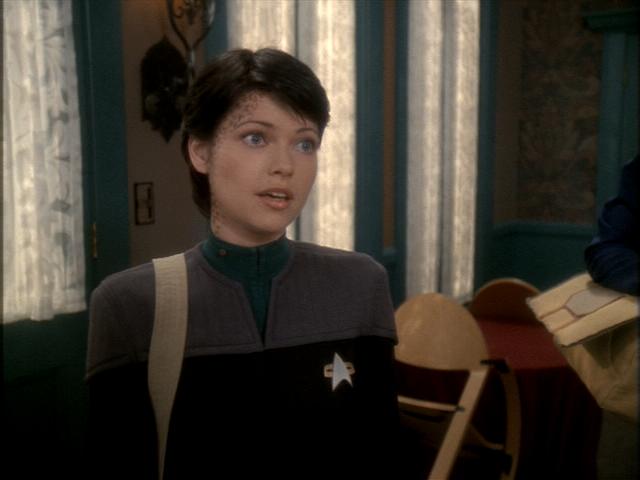
Who Would You Choose for your Star Trek Crew?

Come on, we've all thought about it. At least, those of us who are maximum nerds have. The various Star Trek series have been made even better by the complex characters serving in Starfleet, or for other factions as the stories necessitated. I'm currently watching Enterprise, and while it's no Next Generation, it's nice for satisfying my fix of interstellar intrigue.

Probably my favorite character on the show is Dr. Phlox. He's got that wisdom and compassion that you're always looking for out of each ship's (or station's) chief medical officer. So I got to thinking, is Phlox my favorite doctor from the whole Star Trek universe? Tough call, lots of good doctors out there. And of course, my line of thinking continued: who's my favorite chief engineer? My favorite first officer? And on, and on.

Well, I took the time and put together my "ultimate" Star Trek starship crew, and I invite you to do the same, if you're nerd enough. I recommend you use the same positions in the crew, to make it easier for us to argue. I gave myself a couple of rules:
  1. I could promote officers reasonably, but not demote them beyond where they'd ever appeared in their respective series. So I couldn't assign Benjamin Sisko to be a helmsman.
  2. If it made sense, I could move a crew member into a role they didn't exactly have in their show. An example would be Seven of Nine, whose role was "astrometrics," but might be well-suited for security or tactical roles.
  3. I could have a maximum of four members from any particular crew. For Worf and O'Brien, this would limit both TNG and DS9.
  4. In addition to standard crew members, I allotted one spot for "hospitality," accommodating the various bartenders/chefs from the Star Trek universe.
Captain - Jean-Luc Picard, The Next Generation
Not close. While some other officers might be solid choices, nobody matches the perfection of Picard's balance between diplomacy, intelligence, and guile. He's #1 on my list of captains, without question.

First Officer - William Riker, The Next Generation
I've always liked Riker, though some of that may just be the beard. The most important part of Riker's character, though, is that he's a good counterpoint to Picard. He's forceful, aggressive, and a bit reckless, and he challenges his captain in all the right ways. The dynamic between Picard and Riker is one of the best interplays in the whole Star Trek Universe.

Chief Engineer - Montgomery Scott, The Original Series
You can't watch three episodes of the original series without Scotty drawing "water from a stone," so to speak. He consistently manages to get the Enterprise to do things it shouldn't be able to do. Geordi La Forge seems equally capable, but the tie goes to the better accent.

Chief Medical Officer - The Doctor, Voyager
I liked Julian Bashir in Deep Space Nine, and Phlox on Enterprise, but the Emergency Medical Hologram from Voyager was unquestionably the most entertaining aspect of Star Trek Voyager, and that includes Jeri Ryan in a skintight suit. He was dry and funny, and added some of the "technical limitation" type stories to the series, similar to those involving Data in TNG.

Security Officer - Odo, Deep Space Nine
My initial selection here was Tuvok from Voyager. He's the law-and-order logical type I like. But despite not having any other Vulcans, my ship already had a pretty strong Vulcan feel to it. Picard is very methodical and logical, likewise with Data and The Doctor. Odo, while still fairly logical, is fueled a bit more by a passion for law enforcement, not just an implementation of the "most logical conclusions." Plus, I mean, changeling.

Science Officer - Data, The Next Generation
Data's actual position in TNG is "Chief Operations Officer," but that doesn't have a special ring to it. Also, outside of a few special guests, the Enterprise didn't have a true "Science Officer," and most scientific questions went through Data. Like Odo, his unique physical characteristics can be an asset to a crew, and he proved himself to be a dynamic officer throughout the series.

Helmsman - Travis Mayweather, Enterprise
Enterprise actually has a lot of second or third choices for me on this list. Phlox is awesome, Malcolm Reed is compelling, and Hoshi Sato seems extremely capable. Helmsman might be a less-than-glamorous position, but Mayweather does a great job at it. I like that he's a former freighter crewman, so he might know some deep space tricks, and he seems mature and dependable. The only guy who gets talked about as being possibly a better pilot is Tom Paris from Voyager, but he's a jackass, so Mayweather's my guy.

Counselor - Ezri Dax, Deep Space Nine
Something of an unconventional pick by me here. Ezri is a bit flighty, a bit emotional, and a bit uncertain. But she's got a wealth of experience with the Dax symbiont, and she's a refreshing change of pace from most of the rest of my stuffy crew. Plus she's cute.

Hospitality - Guinan, The Next Generation
While I wouldn't mind getting a little "hospitality" from Robin Lefler, that's not exactly her job. Guinan, throughout her time on Enterprise, offered fantastic advice and a friendly ear to anyone who needed it. Plus, she's been alive for like a thousand years or something, so she knows a thing or two. I enjoyed Quark thoroughly on Deep Space Nine, but bringing him on a ship would just be inviting trouble.

So there you have it, my personal Star Trek crew. Might not make for as entertaining a TV series without the drama brought on by people like Worf or B'elanna Torres, but this crew is getting work done. Post your responses in the comments!

Potential Blog Merge

For those of you unaware, I write another smaller blog, mostly focused on video/board/card games. Technically I share the blog with a couple of friends, but most of the content has been generated by myself. It doesn't get much traffic, but I enjoy the writing, and the few people who read it seem to enjoy it.

To simplify my writing experience, and to keep my blogging fresher, I'm considering merging the two blogs together into a single Joe-based blog. It would feature both sports content as well as gaming content, as well as whatever else might be on my mind on a given day that I feel like writing about.

My question is, to the few of you who read this blog, would you have any objections to the combined content? I would import most of the old sports content into the new blog, but it would be intermixed with content from my other blog. If you have feedback, post it in the comments. Thanks!

Monday, July 14, 2014

Halls of Fame

So this was originally going to be a post about Pau Gasol.

I was reading some article on ESPN about this year's offseason and the implications of various players signed, traded, or drafted, and the author passingly mentioned how Pau Gasol is a Hall of Famer. I tried to keep reading on, but that one point really stuck in my craw, so I did what Joe and Joe always do: I went to Basketball-Reference and pored over stats.

I reviewed similar players statistically, like Mark Agguire and Tom Chambers (non-HOFers) and Alonzo Mourning and Robert Parish (HOFers). The differences were unexceptional; usually it was a matter of championships. But can you really just declare that, because Mourning got a title as the 6th option on the 2005-2006 Heat, that puts him over the top? Seems inappropriate.

So, my investigation took me further, comparing this player to that player, trying to adjust across eras, and taking into consideration various players from the game today who are "lock" HOFers (Dwyane Wade, Tim Duncan, Kevin Garnett), and who oughtn't be but you could see people sticking up for (Lamar Odom, Antawn Jamison).

But as I try to get more information, more questions arise, and I have no answers. Will Chris Bosh be a member of the Hall of Fame when it's all said and done? He's likely to finish with numbers around Gasol's, and he's got a pair of titles with the Heat. Tim Duncan is a surefire Hall of Famer; what about Parker and Ginobili? They were obviously vital to the Spurs' success, but wasn't Horace Grant also instrumental to the Bulls' success in the mid-90s? Less than Jordan or Pippen, but still important. Grant went to one All-Star game in his career; Ginobili's been to two. And Jamison has scored an awful lot of points. Will that be enough to warrant immortality? It wasn't for Bernard King, but who knows.

Baseball used to be easy to wrap your head around. Certain statistics were benchmarks, but then came the steroid era, throwing that into the wind as well. So now, we rely on a combination of statistics, championships, anecdotes, and a "smell test" to determine who deserves to be enshrined forever. Is Alonzo Mourning on that list? Apparently. And if he is, I suppose Gasol deserves to be there too.

I'm not really sure where this blog post ended up. But I think you can count on more posts about the Halls of Fame.

Sunday, January 8, 2012

Is Jorge Posada a Hall of Famer?

Joe emailed me late Saturday and posed an intriguing question: "Is Jorge Posada a Hall of Famer?"

This is a pretty good question. My initial thought without looking at anything is "No, Posada was a good player on some great teams, but was never Hall of Fame caliber". But since that was just my gut reaction, I took some time and looked into it.

Because the physical demands of the position are orders of magnitude higher than any other position on a baseball field, catchers can really only be compared against themselves. There have been three catchers admitted to the HOF since 1989: Johnny Bench, Carlton Fisk and Gary Carter (not counting the 2006 induction of former Negro Leaguers Biz Mackey and Louis Santop...sorry guys but I've got no point of reference for the Hillsdale Giants in the 1920s). Additionally, there is almost no doubt that Mike Piazza is headed to the Hall of Fame, since his offensive numbers would be good enough to warrant admission regardless of his position (400+ homers and a lifetime .308 batting average) and are better than Bench, Fisk and Carter. So with that in mind, to make Posada's case for the HOF his numbers should be in line with those four guys.

Here are the lifetime stats:

Bench: 389 HR, 1376 RBI, .267/.342/.476 in 8669 PA

Fisk: 376 HR, 1330 RBI, .269/.341/.457 in 9853 PA

Carter: 324 HR, 1225 RBI, .262/.335/.439 in 9019 PA

Piazza: 427 HR, 1335 RBI, .308/.377/.545 in 7745 PA

Posada: 275 HR, 1065 RBI, .273/.374/.474 in 7150 PA

From this comparison, it's easy to see that Posada clearly has the weakest offensive numbers of the bunch. This being a straight up comparison, it doesn't take into account the fact that Posada played in a much more favorable offensive environment (scoring was up approximately half a run per game than when Bench, Fisk and Carter played). By not being able to match the offensive numbers of recent HOF caliber catchers in a much more favorable offensive era, it's really hard to make the case that Posada is in the upper echelon of all time hitting catchers.

Of course as I mentioned at the start, there is more to catching than just hitting. Of the five guys I'm comparing, only Piazza and Posada lack a Gold Glove (Bench has nine, Carter four and Fisk one). While that may be an arbitrary award, it at least gives some idea of whether or not a guy is making a difference in the game defensively, something that can be very difficult to quantify. Something that is less difficult to quantify is career caught stealing percentage where, again, Posada is near the bottom of the list (Bench an unreal 43%, Fisk 34%, Carter 35%, Posada 28% and Piazza 23%). If you want a more "SABRmetric" view of their defensive abilities, only Posada (-2.9) and Piazza (-8.3) have negative lifetime defensive WARs, while Bench (6.5), Fisk (2.6) and Carter (10.0) were all improvements over the "average" defensive catcher. It may not be as clean as the offensive comparison, but by looking at several defensive minded stats and awards we can see that Posada was not a very good defensive catcher and was certainly not in the same class as Bench, Fisk and Carter (and who really cares if Mike Piazza was playing any defense with the way that guy raked).

Jorge Posada had a very good career and was part of four World Series champion teams, but ultimately both offensively and defensively he falls short of the elite receivers of the game. He also doesn't have a pop song named after him (but not at all about him) like Mike Piazza, something I hear the HOF committee puts a premium on.

Thursday, August 19, 2010

Completing the Circle?

The Dream Team was honored at the Hall of Fame last week. Only two of the members of the 1992 Olympic basketball team are not already in the Hall as individuals: Chris Mullin and Christian Laettner. (Karl Malone and Scottie Pippen were inducted this year.) Should Laettner and Mullin be in the basketball Hall of Fame as well? Let's have a look.

Christian Laettner

Laettner had a nice NBA career, averaging 17 points and 8 rebounds per game over his first five seasons. But he played on some really bad teams, including the near-expansion Timberwolves and the donkey ass Wizards of the early 2000's. His only sniff of a championship caliber team came with the 2004-2005 Heat as a role player, his final NBA season. The team lost in the Eastern Conference finals to the Pistons.

But if Laettner were to be considered for the Hall of Fame, it would be based on his college performance less than his NBA career. He was the best player on the best team of his era, hitting clutch shots, and frustrating fans of the Michigan Wolverines and their "Fab Five" superstar recruiting class. He's the only player ever to start in four consecutive Final Fours. He holds the record for most points scored in NCAA Tournament play.

The logical comparison case is Bill Walton. Walton's NBA career bore a resemblance to Laettner's, featuring averaging about 16 points per game in his first five seasons, but he was definitely a better defensive player. Walton pulled down 12+ rebounds per game in each of his first four seasons, and had 2.5+ blocks per game in three of those four campaigns. Perhaps most importantly, his teams were a lot better than the Timberwolves ever were.

Walton also had a more illustrious college career, being the centerpiece of the unreal 88-game winning streak by UCLA in the mid-70s. And there's the main difference between Walton (a HOFer) and Laettner: hardware. Walton managed to garner an NBA MVP trophy in 1978 (not sure how, with just 19 points and 13 rebounds per game, and only playing in 58 games). He's also got two each of NCAA championships and NBA championships, and he was named Finals MVP in 1977 for the Portland Trail Blazers.

The reality is that Christian Laettner doesn't come close to Walton in terms of overall performance; Walton was a better college player, and a far better professional player than Laettner. Perhaps a better comparison to Laettner would be Vin Baker (who by the way was my favorite player in Electronic Arts' Live '95 game for Super Nintendo).

Verdict: Not a Hall of Famer.

Chris Mullin

I chose to review Mullin second because he's basically Laettner, except better. Mullin was a superstar at St. John's, winning Big East Player of the Year honors three times in his four years, as well as being named an All-American three times. Additionally, he won Olympic gold in 1984, eight years before he did it again with the Dream Team.

Mullin was drafted seventh overall by the Golden State Warriors in the 1985 NBA Draft, in a draft that saw power forwards or centers get drafted with 15 of the first 17 picks. He contributed immediately, sliding into the starting lineup by the middle of his rookie season, and 14 points per game. His scoring average increased over his first four years, up to a career high of 26.5 in 1988-89. He scored at least 25 points per game over the next four seasons as well, guiding the Warriors to five consecutive playoff appearances. He also made better than 50% of his field goals, remarkable for a spot-up shooter.

His performance over this period earned him his spot on the 1992 Olympic team, and he took full advantage. He may not have provided any memorable highlight reel dunks or passes, but Mullin was the 4th leading scorer on a team of legends, despite starting only two of the team's eight games.

Unfortunately, injuries took away parts of four seasons, as Mullin missed 140 games over that period, preventing him from building on his Olympic success. By the time he was fully healthy and able to play a full season's worth of games, he was 33, and his skills had begun to fade. He'd never again break 15 points per game, and his career faded out of memory.

So how do we judge him? Comparing him to Walton is pretty fair; he was a dominant college player who had success in the pros. Walton picked up an MVP trophy, but I'd say Mullin was more productive, so we'll call their NBA careers, production-wise, a wash. So the question is this: Does Mullin's Olympic and college success measure up to Walton's college dominance, and the NBA title he pulled in?

Answer: Almost. Walton's NBA championship is impressive, and he was clearly an integral part of the team, rating second in scoring and first in rebounds and blocks on that Trail Blazer team. But I can't give top credit to Mullin for either of his two Olympic golds, for the same reason I don't assign much value to Walton's second title with the Celtics in 1986. Mullin was important to his two gold medal teams, more important than Walton was to those Celtics, but not nearly as important as Walton was to the Portland team.

The final piece of the puzzle is this: While Mullin was a prolific scorer, he never led the league in scoring. Granted, this was during Michael Jordan's heyday, but if a player is going to be elected to the Hall of Fame as a prolific scorer who never won a title (in the NBA or college), he'll have to have led the league in scoring at some point. If Dominique Wilkins can't get in, neither can Mullin.

Verdict: Not a Hall of Famer

I think it's important to note that, specifically with Chris Mullin, this isn't a slouch we're talking about. He's one of the all-time greats, maybe the second-best player in Warrior history behind Wilt Chamberlain, and certainly their best player since moving out west. But the Hall of Fame isn't (and shouldn't be) about being a good player, or being the best player over a short period for one time. It's about being a legend. And we should reserve that for the elite.

And yes, I'm looking at you, baseball.

GoodPointJoe's 2024 In Review - Games

Games are a little tougher to judge, because frankly I play a lot of games that I don't finish, but often I don't finish them like, ...